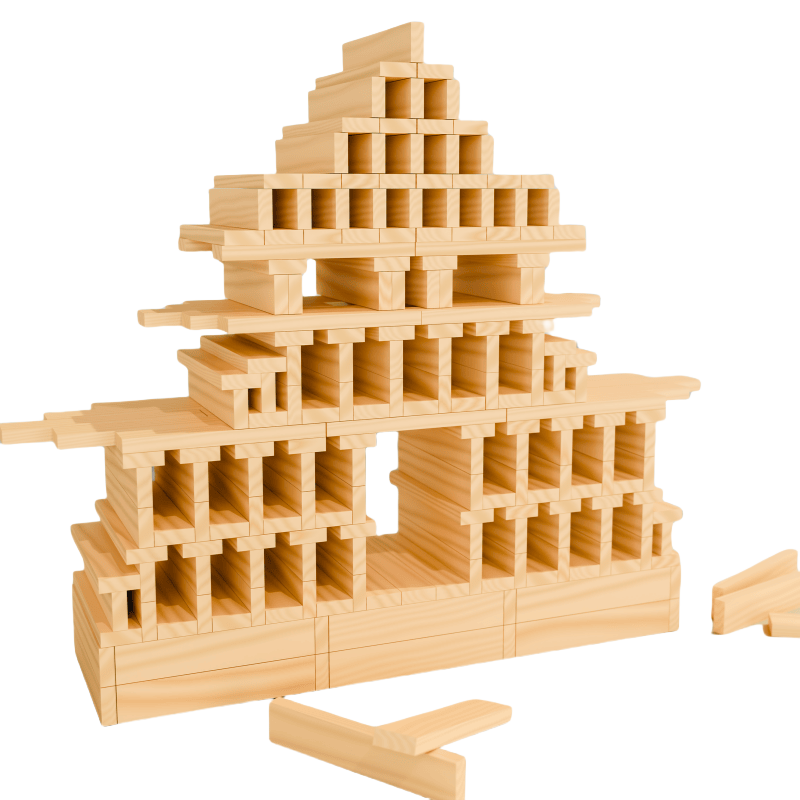
How Many Building Blocks Do You Need? Piece Count by Build and Age
The short answer
For a family with children aged 4–9, buy 200 pieces. For one child under five, 100 is enough. For a classroom, 500 per group of four children. Everything below explains why those numbers are what they are, because the right size depends on what you intend to build rather than on the child's age.
Piece count by structure
These are working estimates for standard plank proportions. They assume a structure roughly 30 cm tall.
| Structure | Planks needed | Notes |
|---|---|---|
| Single tower, 30 cm | 60–80 | Most of it is base; the visible tower is a small fraction of the count |
| Wall, 30 × 40 cm | 80–100 | Two-plank thickness doubles the count |
| Bridge, 30 cm span | 120–150 | Two abutments at 40–50 each plus the span |
| Arch, 30 cm span | 100–120 | Cheaper in planks than a beam bridge for the same span |
| Castle with four towers | 350–500 | Where 200-piece sets run out |
| Domino run, 3 m | 40–60 | The cheapest structure per metre |
Why base area dominates the count
The rule of thumb for stability is that the footprint should be at least a third of the final height. A 30 cm tall tower therefore wants a base about 10 cm across — and a 10 cm solid base, three layers deep, is already 30–40 planks before the tower starts. Buyers consistently underestimate this, buy a 100-piece set, and discover they can build one good tower at a time.
Piece count by situation
| Situation | Recommended | Why |
|---|---|---|
| One child, 3–4 years | 50–100 | Play is carrying, sorting and knocking down, not building tall |
| One child, 5–7 years | 100–200 | Towers, walls and simple bridges |
| Family, two children 4–9 | 200–300 | Two builders need two bases |
| Classroom, 4 children per group | 500 per group | Group projects and a shared structure |
| Exhibition or retail display | 1,000+ | Floor-scale builds |
Is more always better?
No, for two reasons. Storage becomes a problem above about 500 pieces, and a large pile changes the play: children stop planning and start scooping. The most productive count is the one where the child has enough to finish an idea but not so many that the pile becomes the activity.
The practical test: if the child regularly abandons builds halfway, they either have too few planks for their ambition or too many to organise. The first is more common.
How sets are actually sized
Set sizes are usually chosen for packaging and price points rather than for build capacity, which is why 100, 200 and 500 are the common numbers: they fit a carton and a shelf price. A 200-piece set is not twice as much fun as a 100-piece set; it is roughly twice as many structures you can finish.
When to buy the next size up
Three signals, in order of reliability:
- The child starts dismantling earlier builds to reuse the planks.
- Builds are consistently smaller than the child wants them to be.
- Two children want to build at the same time.
Any one of these means the next size up will be used. None of them means the current set was a mistake.
For volume buyers
If you are sourcing sets for resale, piece count maps to price band and carton economy more than to anything else. Our wholesale page lists MOQ by set size; the buying guide covers wood species and tolerance specifications.
Sourcing wooden building blocks for retail or your own brand?
MOQ, lead times, EN71 / ASTM documentation — quoted within one business day.
Start here
Step-by-step tutorials · Building tips · Buying guide · FAQ · Wholesale & OEM