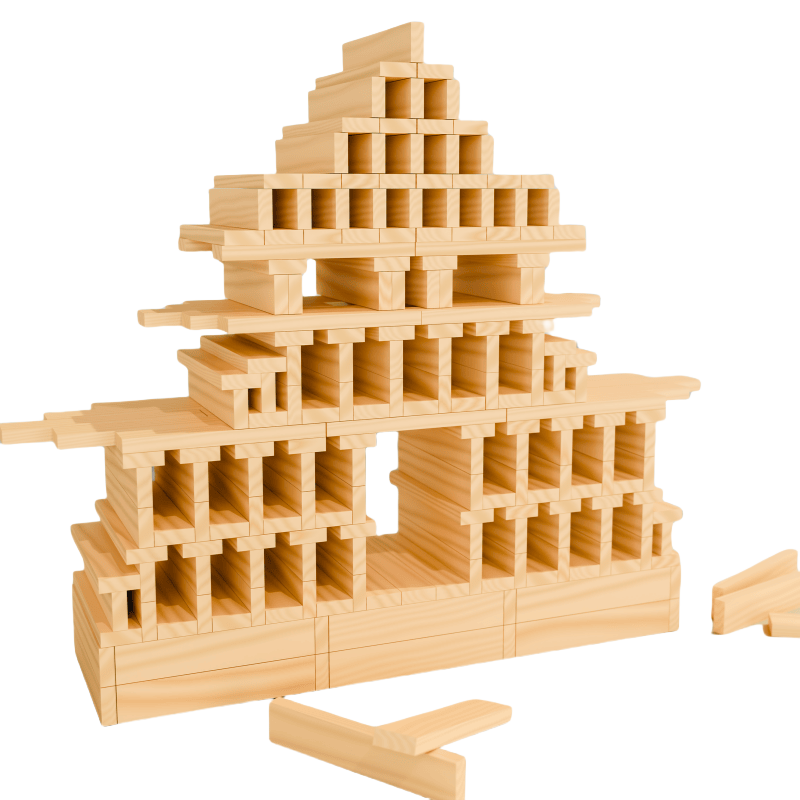
Which Block Series Is Right for You: Natural, Colour or Shapes
The three series, in one table
| Natural wood | Colour | Creative shapes | |
|---|---|---|---|
| Finish | Clear water-based seal or oil | Water-based colour | Clear or colour |
| Look | Grain and tone visible | Flat uniform tone | Same as base series |
| Photographs | Variation between pieces | Consistent | — |
| Compliance | Simplest (no pigment) | Needs EN71-3 by colourway | Depends on finish |
| Best for | Material-led brands, Montessori positioning | Retail shelves, gift sets | Owners adding range |
| Piece dimensions | Standard plank | Standard plank | Standard plank plus profiles |
Choose natural wood if…
…your positioning is about material honesty: unpainted, no plastic, wood as the design. Natural finish is also the easiest series to take through compliance, because the coating carries no pigment, and it is the fastest to sample because no colour matching is involved. The trade-off is that tone varies between pieces and between production runs, and your product photography has to embrace that rather than fight it.
Read the natural wood series details.
Choose colour if…
…you sell where the shelf does the deciding. A coloured set photographs consistently, reads as a finished gift rather than a craft material, and lets a teacher build sorting and pattern exercises into free play. The complication is compliance: EN71-3 is a coating test, so each colourway needs its own report, and a clear-finish report covers none of them.
Read the colour series details.
Choose creative shapes if…
…the customer already owns planks. Shaped pieces — half-rounds, triangles, short pillars — unlock builds that rectangles cannot make: ramps, corners, pitched roofs, elevated piers. They are an add-on, not a starting point: a child with fewer than 100 planks will get more from more planks than from shapes.
Read the creative shapes details.
Can the series be mixed?
Yes, and they should be. All three series share the same plank dimensions and the same ±0.3 mm thickness tolerance, so a coloured piece can replace a natural piece in a layer without changing the height of that layer. Mixing is where the product becomes a system rather than three separate toys: a natural structure with a coloured roof, or an arch made from natural planks with shaped pieces forming the curve.
What buyers usually get wrong
- Starting with shapes. Shapes extend a set; they do not replace one.
- Choosing colour for a "natural" brand. The positioning and the product contradict each other on the shelf.
- Ordering colour without per-colourway test reports. The one document that matters is the one for the colour you are actually shipping.
- Mixing suppliers. Two manufacturers' planks differ in thickness by enough to make towers lean. If you build a range, build it from one tolerance standard.
Sourcing all three
Standard configurations start at 500 sets per series; custom colours, custom piece mixes or custom packaging start at 1,000 per SKU. Because all three run on the same plank dimensions, a mixed container is straightforward.
See wholesale and OEM for terms, or send your requirement for a quote within one business day.
Sourcing wooden building blocks for retail or your own brand?
MOQ, lead times, EN71 / ASTM documentation — quoted within one business day.
Start here
Step-by-step tutorials · Building tips · Buying guide · FAQ · Wholesale & OEM