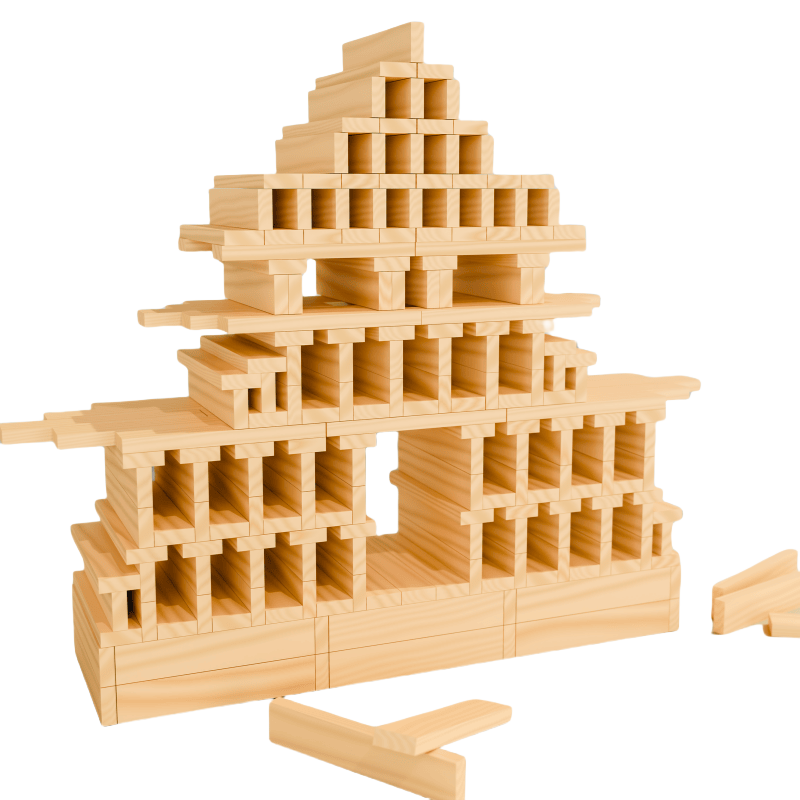
How to Choose Wooden Building Blocks: Set Size, Wood and Consistency
Three questions decide almost everything
Most buyers of wooden building blocks ask about colour or box design first. The three questions that actually determine whether the set gets used are: how many pieces, which wood, and whether the pieces are consistent. Everything else is decoration.
1. How many pieces?
Plank sets are limited by quantity far more than by finish quality. The most common reason a set is abandoned is that the child runs out of planks halfway through an idea.
| Set size | What it supports | Best for |
|---|---|---|
| 50–100 | A tower, a wall, simple shapes | One child, 3–5 years |
| 200 | Towers, bridges, arches, domino runs | Family with children 4–9 |
| 500 | Multi-part structures, classroom projects | Schools, clubs, siblings |
| 1,000+ | Floor-scale builds, exhibition work | Museums, events, retail displays |
If you are choosing between a smaller premium set and a larger budget set for a child under nine, take the larger one. A 200-piece set of ordinary blocks will be used more than a 60-piece set of beautiful ones.
2. Which wood?
Three species cover almost everything on the market:
- Beech — dense, hard, holds a crisp edge. Stacks very consistently and takes a fine finish. The most expensive of the three.
- Pine — light and cheap, but dents and splinters more easily, and the softer grain wears at the corners over time.
- Rubberwood — the usual export choice. Hard enough to hold an edge, widely available, and a good balance of cost and durability.
What matters more than species is moisture content. Kiln-dried wood should sit at 8–12%. Wetter wood bows in a dry warehouse, and a bowed plank never sits flat again. Ask a supplier for the moisture figure; if they cannot give one, that tells you something.
3. Are the pieces consistent?
This is the specification almost nobody checks and the one that decides whether towers stand. Plank structures are unforgiving about thickness: a 0.5 mm variation across a set is enough to introduce a lean that compounds over twenty layers.
- Thickness tolerance should be ±0.3 mm or better.
- Edges should be chamfered consistently along the length — uneven chamfers mean a worn cutter.
- Every piece should sit flat on a hard surface with no rock.
A cheap set built from mixed batches will feel wrong in the hand without the buyer being able to say why. That feeling is dimensional drift.
What about finish and paint?
Water-based, non-toxic finishes are the norm among reputable manufacturers. Two practical checks:
- Open a freshly sealed carton and smell it. A strong solvent smell means the finish has not cured, or is a cheaper coating than the one specified. It will not improve in a container.
- Ask for the EN71-3 test report by colourway. Heavy metal migration is a finish property, so a report for a clear finish does not cover a painted one.
Age: what the label means and what it does not
Most sets are labelled 3+. That is a safety minimum, not a statement of what a child can do. Under three, thin planks get stepped on and snapped and the failure rate is high enough to be frustrating. From four, plank building becomes genuinely productive. At seven to ten, children set their own structural challenges.
What to skip
- Novelty shapes that only build one thing. A set that can only make a car will be built twice.
- Printed instructions that show a single finished model. Look for step sequencing, not a picture of the result.
- Very large sets for very young children. A thousand planks is a storage problem and a tripping hazard before it is a toy.
For buyers sourcing at volume
If you are buying for resale rather than for a child, the questions shift to MOQ, lead time, packaging and compliance documents. Our wholesale and OEM page covers MOQ by set size, sample lead times and which standards we test to; the pre-shipment QC checklist covers what to inspect before a container leaves.
For building ideas to judge a set by, start with your first five builds.
Sourcing wooden building blocks for retail or your own brand?
MOQ, lead times, EN71 / ASTM documentation — quoted within one business day.
Start here
Step-by-step tutorials · Building tips · Buying guide · FAQ · Wholesale & OEM