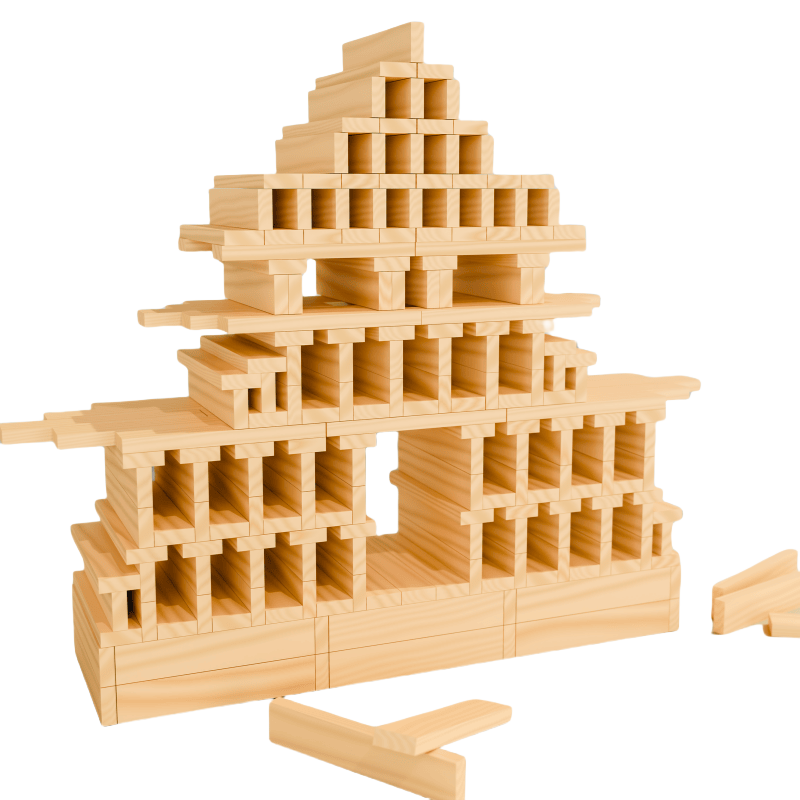
Your First Five Builds: A Beginner Plank Block Tutorial
Before you start
Plank blocks have no connectors, so the first ten minutes are usually a series of collapses. That is not a sign you are doing it wrong. The five builds below are ordered so that each one teaches the skill the next one needs. Work through them in sequence and the physics stops feeling random.
Use a flat, hard surface. Carpet absorbs the small vibration that would otherwise topple a build, and it teaches the wrong lessons. A table or a wooden floor is ideal.
Build 1 — the three-layer platform
The simplest stable structure in plank building: a solid square of planks, three layers high, with the direction alternating each layer.
- Lay planks side by side until you have a square roughly 7 planks by 7 planks.
- On the second layer, run the planks at 90 degrees to the first.
- Repeat for a third layer.
What it teaches: direction changes. If you build three layers all running the same way, the stack splits along the grain lines. Alternating them locks the platform together, and you can feel the difference immediately when you press on a corner.
Build 2 — the pillar tower
Take the platform from build 1 and add four or five pillars, spaced evenly, each two planks wide. Bridge the pillars with a single layer running the other way. Repeat twice.
What it teaches: load paths. Weight travels down through the pillars, not through the empty space between them. Once you can see that, you can start removing material without weakening the structure — which is the whole idea behind arches and bridges.
Test it: press gently on the top layer. A good pillar tower returns to vertical. If it stays slightly displaced, one pillar is taking more load than the others — usually because it is one plank longer.
Build 3 — the flat arch
Place two stacks of planks 25–30 cm apart as abutments. Now build a curve between them by laying planks in a shallow arc, each one resting on the one below rather than on the table.
The trick is to keep the curve shallow. A steep arch falls inward while you are still building it; a shallow arch holds itself up almost immediately.
What it teaches: compression. Every plank in an arch pushes against its neighbours, so the arch is stable even though nothing is glued. This is the single most satisfying build for children aged 7–10, because the arch visibly supports itself.
Build 4 — the cantilever
Build a heavy base — at least six layers — then extend planks out over the edge, one layer at a time, each layer extending one plank further and running at 90 degrees to the layer below.
Measure how far you can extend before the far end drops. Then add a counterweight of planks on the opposite side of the base and measure again.
What it teaches: counterbalance. Children discover that the structure does not fail because the overhang is long, but because the centre of gravity has moved outside the base — and that adding weight on the other side buys a surprising amount of extra reach.
Build 5 — the staircase
Each step is a small platform one layer higher than the last, with the vertical face supported by a column of planks directly below it. Do not try to support a step from the side; it will shear off.
What it teaches: planning. A staircase only works if you decide the number of steps and the rise per step before you start, because changing your mind halfway means rebuilding from the bottom.
What to do when it falls
Look at where the pieces landed before you rebuild.
- Scattered outward — the base was too narrow for the height.
- One block slid off intact — a seam was stacked directly on another seam.
- Folded sideways at mid-height — the upper layers were too heavy for the pillars below.
- Collapsed while you were still placing a piece — you pressed down instead of resting the piece. Place, then release; never press.
Each pattern tells you which rule to change. For the mechanics behind rules two and three, see the building tips section; for age-appropriate expectations, see the buying guide.
How many planks you need for these five builds
Builds 1 and 2 need about 60 planks. The arch needs 40 for the abutments plus 20 for the curve. The cantilever needs 80–100 because the base has to be heavy. The staircase needs roughly 10 planks per step.
A 200-piece set covers all five with room to spare, which is why it is the size we recommend for a family. A 100-piece set will do builds 1, 2 and 3 comfortably.
Sourcing wooden building blocks for retail or your own brand?
MOQ, lead times, EN71 / ASTM documentation — quoted within one business day.
Start here
Step-by-step tutorials · Building tips · Buying guide · FAQ · Wholesale & OEM