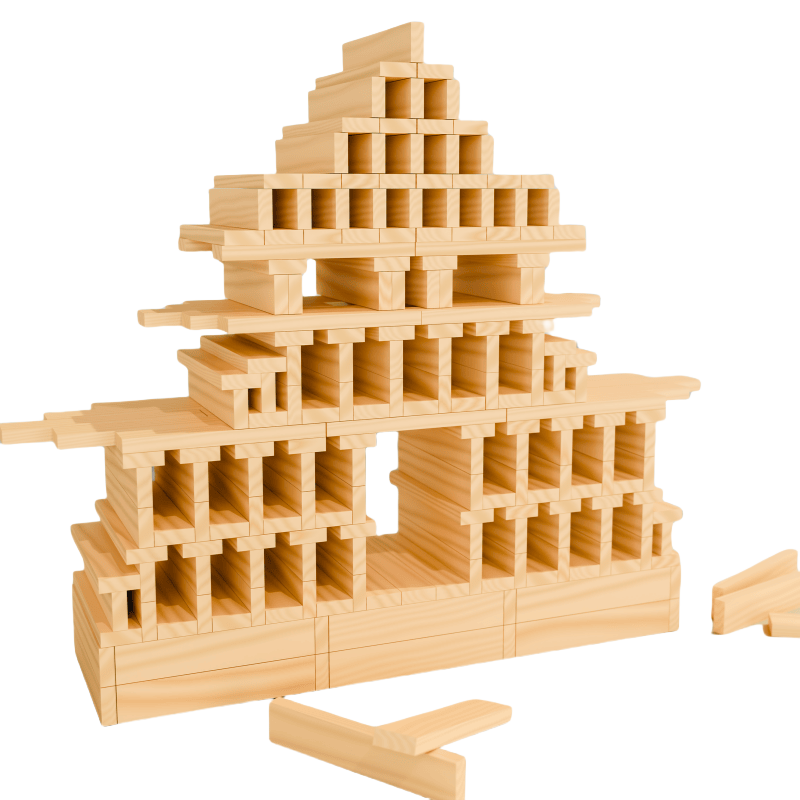
Why Plank Structures Collapse: Six Causes and How to Fix Them
Collapse is a structural problem, not a concentration problem
Almost every plank structure that falls does so for one of six reasons. None of them are about being careful enough. Learn the six patterns and you can diagnose a build in seconds instead of rebuilding it blindly.
1. A base that is too narrow for the height
The footprint should be at least a third of the intended height. A structure 30 planks tall wants a base about 10 planks across. This is the most common fault and the easiest to fix — and it is almost always the fault that shows up first, because a narrow base looks more elegant while you are building it.
2. Stacked seams
Every layer has a seam where two plank ends meet. If the seam in layer two sits directly above the seam in layer one, the structure has a hinge running through it. The fix costs nothing: offset every seam by at least half a plank length from the layer beneath.
Builders who are new to planks naturally centre pieces over the piece below, which produces exactly the stacked seam you want to avoid. Lay the planks out with the ends deliberately staggered.
3. Too little overlap between layers
Bricks work because each one overlaps two below it. Planks need the same treatment: a plank resting on only one plank below is a lever, not a floor. Aim for at least one third of each plank's length resting on each neighbour, and never let a plank bridge a gap with both ends unsupported.
4. Weight that has drifted too high
A tower does not fall because it is tall. It falls because the centre of gravity has moved outside the base. Every plank added near the top moves that centre upward and makes a small lean much more dangerous.
If you want visual height without the risk, keep the lower half wide and stop adding width at about two thirds of the total height. The tapered shape looks deliberate and the physics stays friendly.
5. Vibration
Plank structures are held by friction. Friction depends on contact pressure, and a table bump or a heavy footstep briefly reduces it. Two habits help:
- Leave a 10–20 mm gap between neighbouring planks rather than pressing them tight. Tight planks transmit vibration straight through the structure; loose planks absorb it.
- Build on a hard surface away from a walkway. On carpet the structure is less stable, not more, because the surface gives way unevenly.
6. Placing instead of pressing
The most underrated cause. A plank that is pressed down while being placed transfers your hand's force into the structure below, and a structure already at its limit will move. Place the plank, let it settle, then release. Never push down to seat it.
The three-second test
When the build reaches about half its planned height, press two fingers gently against the side at the top and release. A healthy structure returns to vertical. One that stays slightly displaced is already failing: the load is uneven and the next ten layers will finish it off.
That is the moment to stop and widen the base, not to keep going. Builders almost always keep going, which is why so many impressive-looking towers collapse at the very end rather than in the middle.
Tolerance: why consistency matters more than care
Plank structures are unforgiving about thickness. A 0.5 mm variation across a set is enough to introduce a lean that compounds over twenty layers. This is why reputable sets are machined to ±0.3 mm and why cheap sets built from mixed batches never stack as well, however carefully you place them.
If your planks are inconsistent, sort them into piles by thickness and build the base from the most uniform ones. It sounds excessive; it works.
A quick diagnostic routine
- Look at the base. Is it a third of the height? If not, widen it before anything else.
- Look at the seams. Do they line up vertically? Offset them.
- Look at the top third. Is it heavier than the bottom third? Stop adding there.
- Nudge test. Does it return to vertical? If not, rebuild the bottom ten layers.
For a set of builds that teach these rules in order, see the tutorial section; for the same ideas applied to bridges and arches, see the buying guide.
Sourcing wooden building blocks for retail or your own brand?
MOQ, lead times, EN71 / ASTM documentation — quoted within one business day.
Start here
Step-by-step tutorials · Building tips · Buying guide · FAQ · Wholesale & OEM