Archimedes Blocks FAQ: Age, Set Size, Wood, Safety and Care
What are Archimedes blocks?
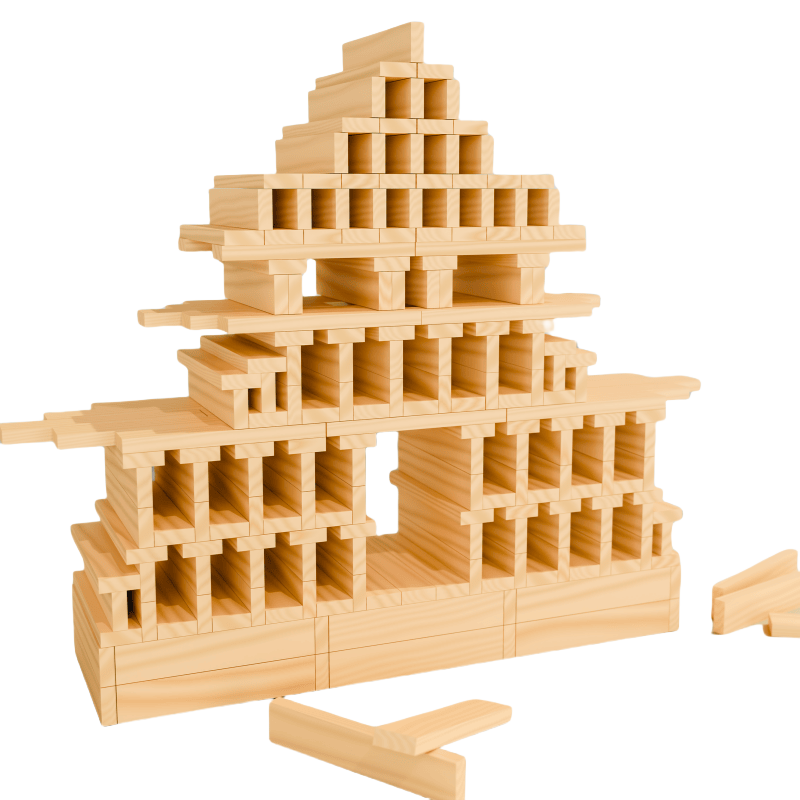
Archimedes blocks are flat, rectangular wooden planks with no connectors, studs or magnets. You build by stacking and balancing: friction and gravity hold the structure together. Because nothing clicks into place, a tower only stands if the base is wide enough and the joints are staggered — which is exactly what makes the toy interesting for children learning about structure and balance.
They are close relatives of what are sometimes called plank blocks, KEVA-style planks or simply open-ended wooden blocks. The name refers to the principle, not to a single brand.
What age are they suitable for?
Most sets are labelled 3+. In practice:
- Under 3 — not the right toy. Thin planks get stepped on and snapped, and a tower that falls over is frustrating rather than fun.
- 3–4 — carrying, sorting, lining up rows, knocking things down. Normal and useful play.
- 4–6 — the real starting point for building. Towers, walls, simple bridges.
- 7–10 — self-set challenges: the tallest tower that survives a door slam, the longest bridge that holds a book.
How many pieces do I need?
Fewer than you think for a child, more than you think for a family.
- 50–100 — enough for a tower or a wall. The most common reason a set gets abandoned is running out of pieces mid-build.
- 200 — the sweet spot for families with children aged 4–9. Towers, bridges and domino runs all work.
- 500+ — classrooms, clubs, and children who build large structures on the floor.
What wood are they made from?
Beech, pine and rubberwood are the three common choices. Beech is dense and holds a crisp edge, which makes for very consistent stacks. Pine is lighter and cheaper but dents more easily. Rubberwood is a good middle ground and is widely used in export production. All of them need to be kiln-dried to roughly 8–12% moisture content — wood that is wetter than that will bow in a dry warehouse and stop stacking flat.
Are they safe for children?
- Look for EN71-1/2/3 (Europe) or ASTM F963 / CPSIA (US) test reports, quoted by report number and date.
- Water-based, non-toxic finishes are standard for reputable manufacturers. If a set smells strongly of solvent when opened, return it.
- Check edges with the tissue test: an edge that tears thin paper is too sharp, however it feels to an adult finger.
- Build on the floor rather than a table once a structure goes above about 40 cm — taller builds can topple onto a younger sibling.
How do you clean them?
Wipe with a barely damp cloth and dry immediately. Do not soak wooden blocks, do not put them in a dishwasher, and do not leave them in a bathroom or a damp garage. Water swells the grain, and a swollen plank never sits flat again. For deeper cleaning, a cloth with a little mild soap is fine as long as you dry the piece straight away.
How is this different from LEGO or magnetic tiles?
LEGO and magnetic tiles connect, so the structure is held together by the connection. Plank blocks have no connection at all, so the child has to make the structure stable through shape and weight. That is a different skill: it teaches balance, load paths and patience rather than assembly. Many families keep both — they are not substitutes.
Why does my tower keep falling over?
Three reasons, in order of frequency:
- The base is too narrow. The footprint should be at least a third of the final height.
- Joints are stacked directly on top of each other, creating a hinge. Offset every seam by at least half a plank length.
- Weight has drifted too high. Keep the lower half of the build wide and stop adding width at about two thirds of the total height.
For a full walkthrough, see how to build a stable tower with wooden planks.
Do you sell wholesale or produce OEM orders?
Yes. We manufacture in Yunhe, Zhejiang and supply retailers, importers and brands. Standard sets start at 500 units; OEM orders with your own packaging or design start at 1,000 units per SKU. See wholesale and OEM for MOQ, lead times and compliance documents, or send us your requirement and we will quote within one business day.
Further reading
- How to choose wooden building blocks — set size, wood species and the tolerances that decide whether towers stand.
- How to clean wooden blocks without warping them — and why water, not dirt, is what ruins a set.
- Your first five builds — five structures in the order that teaches the skills.
- Why plank structures collapse — six causes and the three-second test that catches failure early.
- Wholesale and OEM supply — MOQ, lead times and compliance documents.
Still have a question?
Send it below and we will answer within one business day — the answer goes into this FAQ if it is useful to others.
Sourcing wooden building blocks for retail or your own brand?
MOQ, lead times, EN71 / ASTM documentation — quoted within one business day.
Start here
Step-by-step tutorials · Building tips · Buying guide · FAQ · Wholesale & OEM