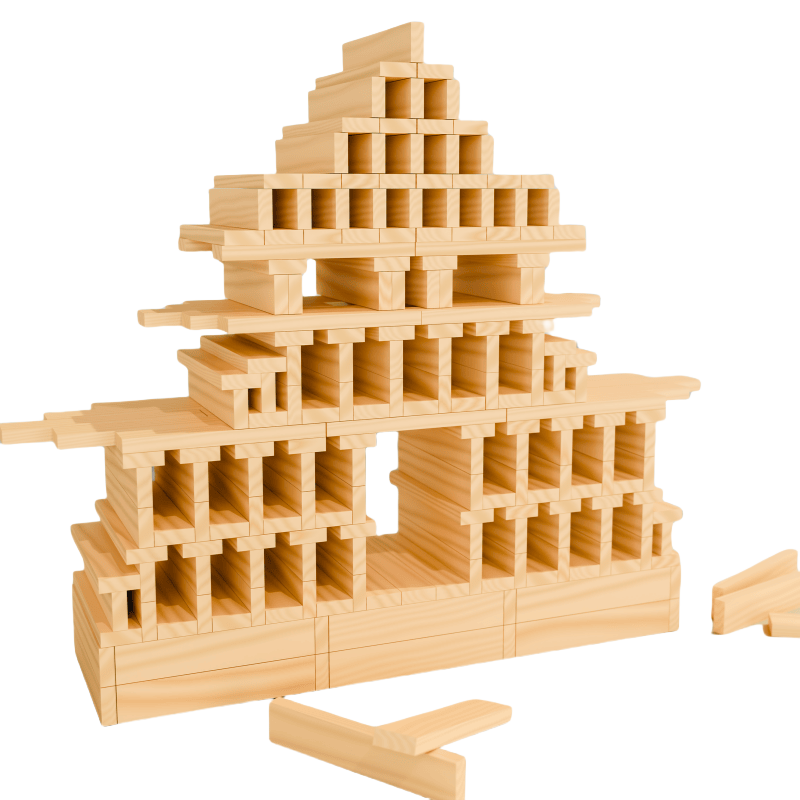
How to Clean Wooden Blocks Without Warping Them
Wooden blocks fail from water long before they fail from wear. A soaked block swells across the grain, dries unevenly, and never sits flat again. Everything below is written around that one fact.
The basic routine
Wipe with a cloth that is barely damp — wrung out until it stops dripping — then dry the piece immediately with a second cloth. Do not leave blocks to air-dry on a draining board, and do not stack them wet.
For everyday dust this is all that is needed. Wood is not a surface that requires frequent washing; it requires frequent wiping.
What never to do
- No dishwashers. The combination of heat, water and detergent is the fastest way to destroy a set.
- No soaking, even in a basin, even briefly. Ten minutes is enough to swell the grain.
- No bleach or alcohol sprays. Both strip the finish and leave the surface rougher, which makes the next cleaning harder.
- No drying in direct sun or on a radiator. Fast drying is what causes the bow, not the water alone.
Disinfecting without soaking
In a nursery or classroom the concern is real, and the answer is not a bucket. Two workable methods:
- Food-safe sanitiser on a cloth: spray a cloth, not the block, wipe the surface, then wipe again with a clean damp cloth and dry immediately.
- Sunlight: ultraviolet light does a surprising amount of the work. Twenty minutes in direct sun, spread out and turned once, is a traditional and effective method — as long as the blocks are dry and not left out in rain.
Whatever you use, finish with the dry cloth. The residue is less of a problem than the moisture.
Sticky residue and marker stains
Tape residue comes off with a cloth dampened with a little cooking oil, then a wipe with mild soap. Marker stains usually sit in the grain and will fade with light sanding rather than with solvent — and a light sand with 240-grit followed by a thin coat of food-safe oil is a better repair than anything chemical.
If a block has already warped
Check it on a flat surface. A wobble of under a millimetre will often settle after a week in a dry room with good airflow, laid flat and separated. A pronounced bow will not come back and should be replaced: a warped plank makes every tower above it lean.
Storage that prevents the problem
- A cloth bag or a lidded box, not a plastic bag — wood needs to breathe.
- Keep sets out of bathrooms, garages and conservatories. The problem is not wet, it is damp that never dries.
- In humid climates, a sachet of silica gel in the storage box is cheap insurance.
- Do not store blocks pressed under something heavy; stacked flat is fine, clamped is not.
Re-oiling: what and when
Oiled and waxed sets benefit from a very thin coat of food-safe oil once or twice a year, applied with a cloth and buffed off after twenty minutes. Do not flood the surface. Varnished or water-based lacquered sets need nothing; adding oil to a lacquered finish makes it tacky.
If the surface starts to look dry and pale, that is the signal — not a calendar date.
How often is 'often enough'?
Wipe after use if the set is used daily. A deeper clean once a month is plenty for a home. A classroom set used by thirty children a day should be wiped daily and sanitised weekly — with the dry-cloth finish, every time.
For the specification that makes blocks easy to clean in the first place (finish type, thickness tolerance, splinter risk), see the buying guide. For wholesale and care-instruction requirements, see wholesale and OEM.
Sourcing wooden building blocks for retail or your own brand?
MOQ, lead times, EN71 / ASTM documentation — quoted within one business day.
Start here
Step-by-step tutorials · Building tips · Buying guide · FAQ · Wholesale & OEM