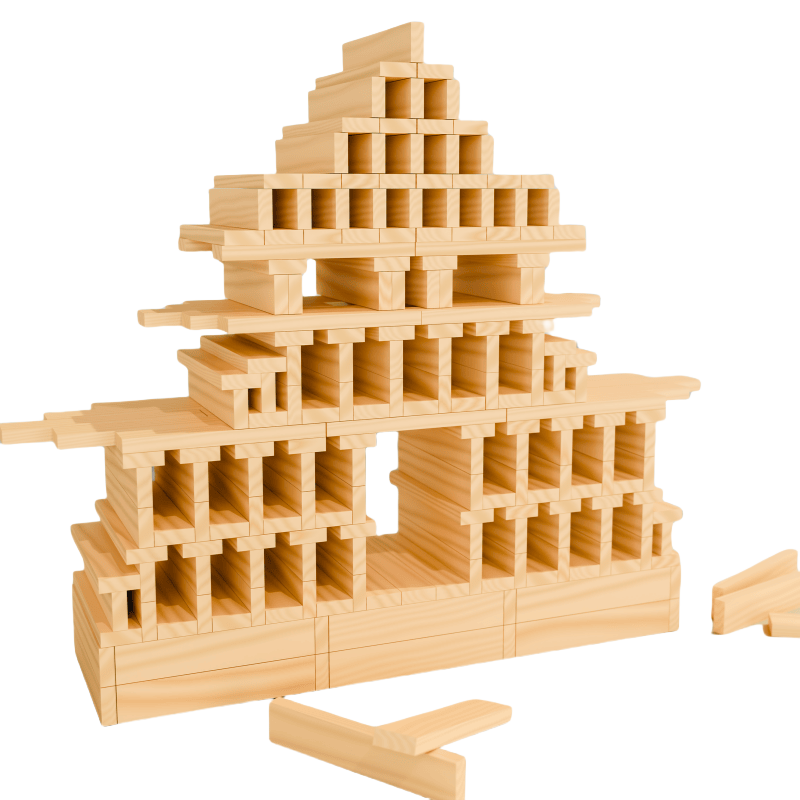
Wooden Blocks vs Plastic Blocks: What Actually Lasts
Most comparisons of wooden and plastic blocks argue about aesthetics. The differences that matter over five years are dimensional stability, how the material fails, and what happens at the end of the toy's life.
How each material fails
Plastic fails suddenly. A dropped brick chips at the corner, and a chipped stud stops gripping. The set degrades one piece at a time until the build you could make last year is no longer possible.
Wood fails slowly or not at all. Edges round with use, which reads as character rather than damage. The real risks are water (which warps a piece permanently) and splitting along the grain if a plank is stepped on.
For a toy that gets thrown into a box every evening, wood is the more forgiving material. For a toy that stays assembled on a shelf, the difference is small.
Dimensional stability
Injection-moulded plastic bricks are dimensionally identical to within a few hundredths of a millimetre, forever. This is why interlocking systems work at all.
Wood moves. It expands and contracts with humidity, and it needs to be machined to ±0.3 mm to stack reliably. A good wooden set holds that tolerance; a cheap one does not, and the difference is invisible until you try to build above twenty layers.
So: plastic wins on consistency, wood wins on everything else — but only if the wood is properly dried and cut.
Safety
- Choking: both are regulated by the same age-based small-parts rules.
- Coatings: both can carry heavy-metal risk in pigments. The test (EN71-3, ASTM F963) applies to the coating, not the material, and must be quoted by colourway.
- Splinters: the one risk unique to wood, and entirely a matter of sanding time. A cheap set will have rough edges; a good one will not.
- Off-gassing: plastic toys can smell of solvent when new; wooden toys finished with water-based coatings should not smell at all. If a wooden set smells strongly, the finish is the problem, not the wood.
What each does better
| Wooden | Plastic | |
|---|---|---|
| Structures that balance | Far better — weight and friction do the work | Needs connectors |
| Interlocking systems | Not what it is for | Far better |
| Sound and feel | Warm, quiet | Click, rattle |
| Repair | Sanding and oil | Not repairable |
| Recycling | Compostable or burnable; often resold | Recyclable in principle, rarely in practice |
| Resale value | Holds a surprising amount | Close to zero |
The five-year test
A plastic brick set and a wooden plank set bought on the same day will be in different condition after five years of ordinary family use. The plastic set will be complete but scuffed, with a few dead pieces. The wooden set will be slightly rounded at the edges, may have lost one or two pieces to water, and will still build exactly what it built on day one.
Neither is better in the abstract. The plastic set teaches assembly; the wooden set teaches structure. Many families end up with both, for that reason.
What to check before buying either
- Wood: moisture content 8–12%, thickness tolerance ±0.3 mm, water-based finish, EN71-3 by colourway.
- Plastic: no sharp flash on the moulding, consistent clutch power across the set, and the same coating questions.
For the wood specification in detail, see the buying guide. For volume sourcing of wooden sets, see wholesale and OEM.
Sourcing wooden building blocks for retail or your own brand?
MOQ, lead times, EN71 / ASTM documentation — quoted within one business day.
Start here
Step-by-step tutorials · Building tips · Buying guide · FAQ · Wholesale & OEM