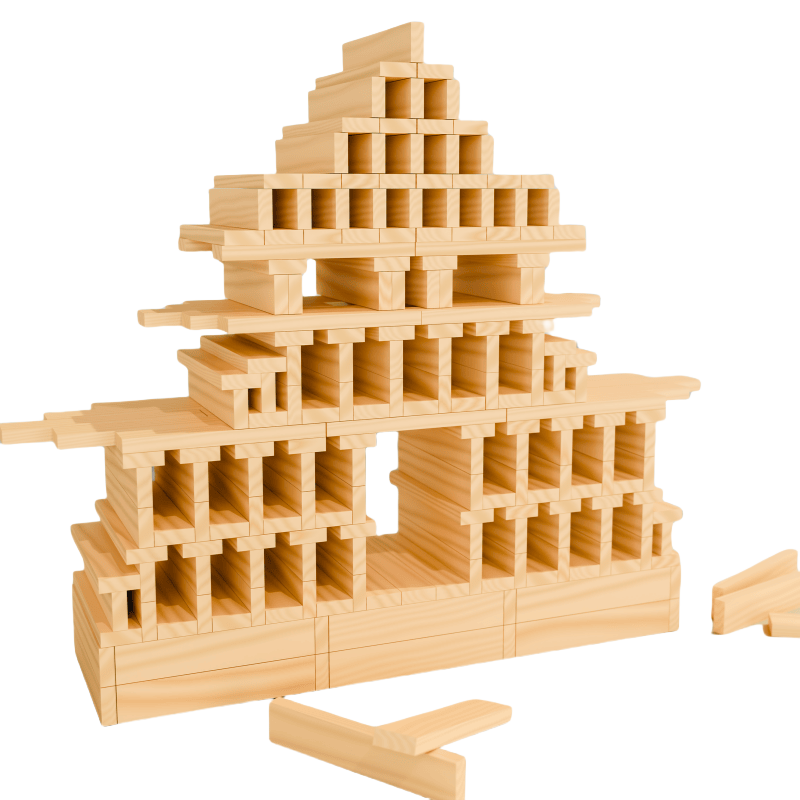
Pre-Shipment QC Checklist for Wooden Building Blocks
Most wooden block complaints are not random. They come from six failure modes — moisture, dimensional drift, sharp edges, finish migration, short counts and packaging damage — and each one is cheap to catch before loading and expensive to fix afterwards. This is the checklist we would run on any plank or block shipment.
Before the inspection: agree the standard
An inspection without an agreed AQL table and a signed golden sample is an opinion, not an inspection. Fix three things in writing first: the sampling plan (AQL 2.5 for major defects and 4.0 for minor is common for consumer goods), the approved sample, and the measurement tolerances.
1. Moisture content
Target 8–12% for kiln-dried hardwood in most climates. Test with a pin meter on at least ten pieces per sample, and test the end grain as well as the face — wood dries unevenly and end grain reads high.
Blocks that ship above 12% will shrink and bow in a dry warehouse, and the bow only appears after the customer opens the box. This single check prevents more returns than any other on this list.
2. Dimensional tolerance
Measure length, width and thickness on a random sample with calipers, not a ruler. Plank-style blocks depend on consistency: a 0.5 mm thickness variance across a set is enough to make towers lean.
State the tolerance in the purchase order. ±0.3 mm on thickness is achievable for a well-set-up line; if a supplier cannot meet it, the fixture is worn.
3. Squareness and warp
Place each sampled piece on a granite block or a verified flat surface. Any rock is warp. Check squareness at the corners with a machinist square. A block that is 1 mm out of square will not stack flat, and the defect is invisible in a photo.
4. Edges and corners
Run a finger along every edge of the sample. Then do it with a piece of thin tissue paper: any edge that tears the paper is too sharp, regardless of how it feels.
Chamfers should be consistent along the length. Uneven chamfers usually mean a worn cutter head, which will worsen across the run.
5. Finish and migration
Visual: no drips, no sanding marks under the finish, no bare patches, colour consistent between pieces in the same set.
Functional: check the supplier's EN71-3 (heavy metal migration) and, if applicable, EN71-9 test reports — by report number, product and colourway. Heavy metal migration is a finish problem, so a report for a clear finish does not cover a coloured one.
6. Drop and impact test
Drop a finished item from 85 cm onto a hard floor, three times, on different faces. Look for cracks at the grain ends and finish flaking. Repeat with a loaded retail carton: drop it on one corner, one edge and one face.
7. Count accuracy
Open three retail cartons from the production run and count the pieces against the packing list. Short counts are one of the most common and most avoidable complaints, and they almost always start in the counting station rather than the packing line.
8. Splinters and loose fibres
Inspect under a bright light at a low angle. Loose fibres around drilled holes and cut ends are a splinter risk in a children's product and a sign that sanding was rushed at the end of a run.
9. Odour
Open a freshly sealed carton and smell it. A strong solvent smell indicates a finish that has not cured, or a cheaper coating than the one specified. It will not improve in the container.
10. Packaging integrity
Check shrink wrap tension, insert fit, printing registration and barcode readability with an actual scanner. Verify the carton burst strength and that the inner divider prevents movement — blocks that shift in transit arrive chipped.
11. Marking and paperwork
- CE mark and importer address present and correctly placed
- Age warning and small-parts warning wording matches the market
- Batch or date code traceable to the production run
- Test reports, material certificates and packing list complete
12. Container loading check
Confirm carton count against the loading plan, photograph the stow pattern, check for floor moisture and verify the container number on the seal. Take photos of the seal itself before it is closed.
What to do with a failed inspection
Separate defects into three buckets: those that stop shipment (safety, sharp edges, migration), those that require rework (counts, packaging, finish blemishes) and those to note for the next order (minor colour variation). Only the first bucket justifies holding a container. Everything else should be priced into a rework agreement rather than becoming an argument at the port.
For the commercial side of the same decision, see OEM vs ODM for wooden toys.
Sourcing wooden building blocks for retail or your own brand?
MOQ, lead times, EN71 / ASTM documentation — quoted within one business day.
Start here
Step-by-step tutorials · Building tips · Buying guide · FAQ · Wholesale & OEM