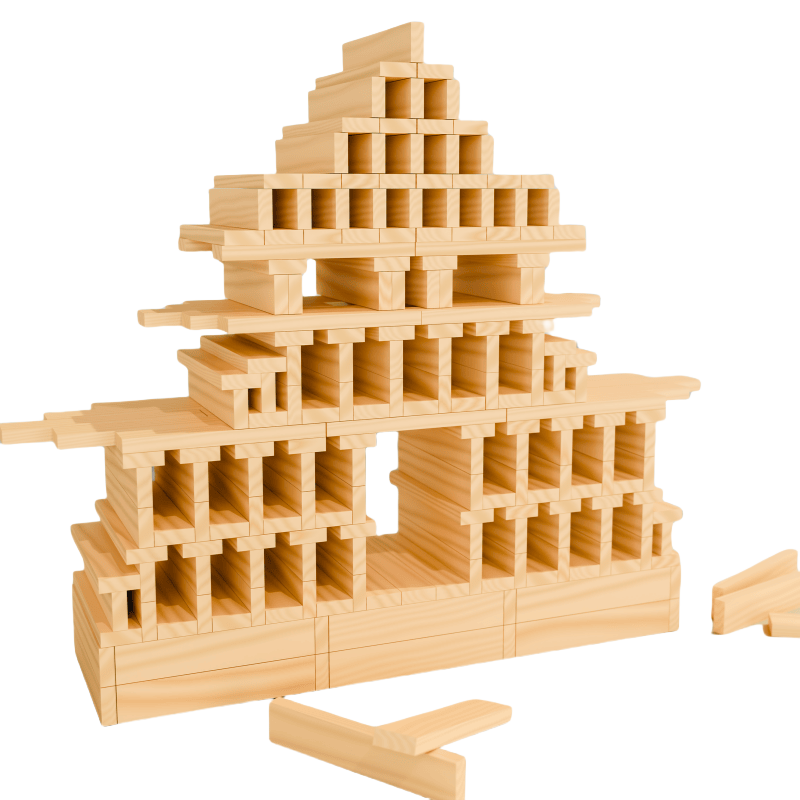
Where Wooden Building Blocks Are Actually Made
One county makes most of the world's wooden toys
Around 70% of China's wooden toy output comes from a single county in Zhejiang: Yunhe, in Lishui prefecture, about four hours south of Shanghai by road. The cluster formed in the 1970s around local timber and has never really dispersed, because the supply chain that supports it — kiln drying, precision cutting, water-based finishing, retail packaging — sits within a few kilometres.
That density explains most of the practical facts a buyer encounters when sourcing wooden building blocks: why sampling is fast, why MOQ is what it is, and why two factories quoting the same product can differ by 40%.
Why the cluster exists
Wooden toys need four things in sequence: dried timber, accurate cutting, thorough sanding and a finish that passes migration tests. In Yunhe each of those is a separate specialist business. A toy factory might buy kiln-dried beech from one supplier, send components out for sanding to another, and use a third for painting before assembling and packing in-house.
The upside for buyers is speed and price. The downside is that the factory you are talking to may not control every step, which matters when something goes wrong with the finish.
What this means for sampling
Stock samples typically ship in three to five days because the components already exist and the sub-contractors are local. A custom sample — new size, new shape, new packaging — takes ten to fifteen days, mostly waiting for cutting fixtures and printed cartons rather than for actual production.
If a supplier quotes you four weeks for a sample, they are either not in the cluster, or they are a trading company placing the order elsewhere.
What this means for MOQ
MOQ in the cluster is driven by setup time, not by raw material. Cutting fixtures, sanding jigs, paint batches and printed cartons each have a fixed cost per SKU. That is why a standard set has a lower MOQ than a custom one, and why changing the packaging is often as expensive as changing the product.
A factory that quotes the same MOQ for a stock set and a fully custom set has not understood the question.
How to tell a factory from a trading company
Roughly half the companies presenting themselves as manufacturers in Yunhe are trading companies. That is not automatically bad — traders can be useful for multi-category orders — but they change your cost structure and your control over quality. Five questions separate them quickly:
- Can I see the workshop that will cut my order, on a video call, while it is running?
- Who owns the cutting fixture, and can I see it?
- Which sub-contractor does the finishing, and are they within the county?
- What is the moisture content of the timber, and who measures it?
- If a shipment fails inspection, who pays for rework?
A factory answers all five with specifics. A trader answers two and defers the rest.
Why identical products differ in price
The gap between the cheapest and the most expensive quote for the same nominal product is usually not margin. It is: species (pine versus beech), moisture control, sanding time, finish type (solvent versus water-based), and whether the packaging is generic or printed for your brand. Two sets that look identical in a photo can differ by 40% on all five at once.
The consequence for buyers is that undercutting on price alone reliably buys one of those five shortcuts, and the shortcut that gets cut first is almost always sanding time — which is the one customers notice first, as rough edges and splinters.
What this means if you are buying for resale
Source within the cluster if you want speed and price; verify the factory rather than the trading company if you want control. Ask for the moisture figure, the thickness tolerance and the finish type in writing before you compare quotes, because those three determine whether the product feels the same in year two as it did on arrival.
For the commercial terms that follow from this, see wholesale and OEM. For the inspection routine that catches the shortcuts, see the pre-shipment QC checklist.
Sourcing wooden building blocks for retail or your own brand?
MOQ, lead times, EN71 / ASTM documentation — quoted within one business day.
Start here
Step-by-step tutorials · Building tips · Buying guide · FAQ · Wholesale & OEM