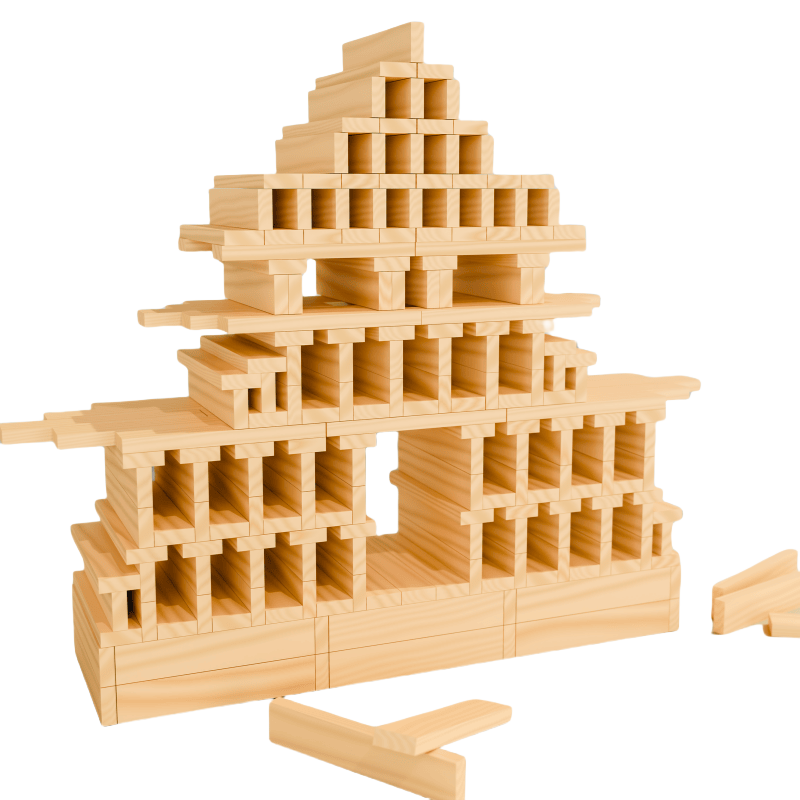
Wooden Blocks for Classrooms: How Many Sets and How to Choose
School block sets fail differently from home sets. They are used by many hands at once, stored badly, cleaned more often, and budgeted against a specification written by someone who has never built with them. These are the decisions that matter.
How many planks per class
Work from groups, not from headcount. Four children building together need about 500 planks to run a session without running out; thirty children working in seven or eight groups therefore need 3,500–4,000 planks, which is usually more than a single budget line allows.
Two workable alternatives:
- Rotate. Two sets of 500, used by two groups at a time while the rest do something else. Cheaper, and the teacher can actually observe.
- Build smaller. Set every group a 200-plank task — a bridge that spans 30 cm, a tower that survives a nudge — and buy 1,600 planks instead of 3,500.
For a single class of thirty with no rotation, 1,500 planks is the realistic minimum for meaningful builds.
What breaks first
- Thin planks underfoot. A stepped-on plank splits along the grain. Thicker stock survives; budget for replacements either way.
- Water damage from cleaning. Sets wiped with a wet cloth and stored damp will bow. This is the single most common cause of a set being written off.
- Lost pieces. Counts drift; a set silently loses 10% a year. Buy a set whose count is printed on the box so losses can be tracked.
- Storage furniture. A deep plastic tub means planks at the bottom sit under load for months.
The specification to put in a purchase order
| Item | Specify |
|---|---|
| Wood | Beech or rubberwood, kiln dried to 8–12% moisture |
| Thickness tolerance | ±0.3 mm across the set |
| Finish | Water-based, non-toxic, EN71-3 tested by colourway |
| Edges | Chamfered; must pass the tissue-paper test |
| Set sizes | Fixed counts (e.g. 200 / 500), stated on the carton |
| Storage | Shallow trays or a lidded wooden box included, not deep tubs |
| Spares | 5% spare pieces per set, or a replenishment price held for 12 months |
Storage that survives a classroom
Three shallow trays per set, on a low trolley, sorted by length. Children can reach it, the set is self-sorting, and the wood is never under load. A deep lidded box is acceptable at a push, as long as it is not full to the brim.
Cleaning policy
Wipe with a barely damp cloth and dry immediately; never soak; never a dishwasher. In a setting with thirty children, a weekly wipe with a food-safe sanitiser on the cloth — not sprayed onto the blocks — followed by a dry wipe is sufficient. Write this into the room’s routine, not just the supplier’s leaflet.
Buying for a group of schools
For a trust or a local authority buying across sites, specify one set size and one storage format everywhere. Mixed specifications make replenishment impossible after two years, and the sets that get used most are always the ones with spares available.
For volume terms, see wholesale and OEM. For the inspection routine before delivery, see the pre-shipment QC checklist. For how many pieces suit individual ages, see piece counts by build and age.
Sourcing wooden building blocks for retail or your own brand?
MOQ, lead times, EN71 / ASTM documentation — quoted within one business day.
Start here
Step-by-step tutorials · Building tips · Buying guide · FAQ · Wholesale & OEM