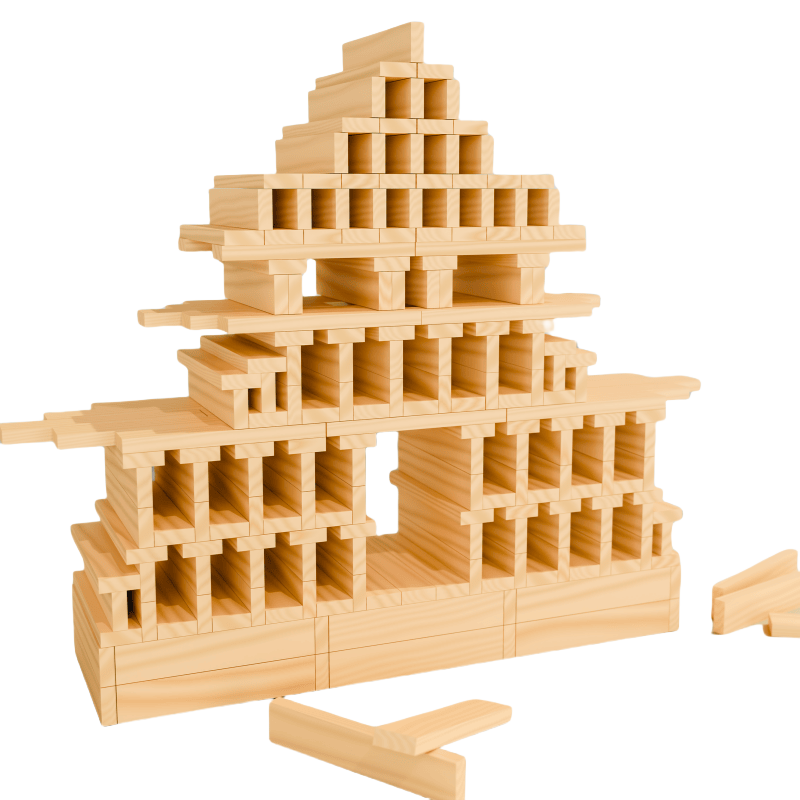
Block Storage That Doesn't Damage the Wood
Storage is where most wooden block sets quietly degrade. Not from being played with, but from being kept somewhere the wood cannot dry out or breathe. A set that lives in a sealed plastic box in a garage will be warped within a year, however good it was.
The two things that damage stored blocks
Moisture that cannot escape. Wood takes on humidity from the air. In a sealed container in a damp room, it absorbs water and has nowhere to release it — the planks swell, then dry unevenly when the box is opened, and the bow becomes permanent.
Load. Blocks pressed under heavy things for months take a set. Stacked flat is fine; clamped, crammed, or stored under a crate of books is not.
What not to use
- Sealed plastic bins in a garage, basement or shed. The worst combination: the dampest rooms plus the least ventilation.
- Vacuum storage bags. Fine for bedding, wrong for wood.
- A conservatory or a windowsill. Wide temperature swings draw moisture in and out daily.
Four storage setups that work
1. The cloth drawstring bag (home, small sets)
Breathable, cheap, and the bag can be thrown into a toy box. Suitable up to about 200 planks. The one downside is that planks sit in a heap, so thin pieces can get bent at the bottom — empty the bag rather than digging through it.
2. The shallow wooden box (home or classroom)
A box no deeper than two planks is ideal: planks lie flat, the child can see what is in it, and nothing is under load. A depth of 15–20 cm fits roughly 300–400 planks.
3. Stacked trays on a trolley (classroom)
Three or four shallow trays, each holding one length, on a low trolley. Children can reach it, the set is sorted by size without effort, and the trays are easy to wipe. This is the setup that survives a class of thirty.
4. Display crates (retail)
For a shop, open crates on a shelf keep the product visible and the wood ventilated. Avoid closed display boxes with plastic windows; they trap humidity and the product smells of the coating after a few weeks.
Location rules
- Anywhere a person is comfortable: bedrooms, living rooms, classrooms.
- Not: bathrooms, kitchens (steam), garages, sheds, unheated conservatories, or against an outside wall that gets cold.
- In humid climates, keep a silica gel sachet in the box and change it twice a year.
Sorting: worth it or not?
Sorting by length in the box is not housekeeping for its own sake. A sorted set is used more, because the child can see what is available, and pieces are less likely to be bent at the bottom of a heap. A set of simple dividers or three trays is enough.
Long-term storage
For a set that will sit unused for months: clean and dry it thoroughly, store it flat in a breathable bag or box in a dry room, and check it once a season. Do not oil it before storing — oil plus a sealed container is a recipe for a rancid smell.
What this means if you are buying for resale
Packaging is storage for the first months of a product's life, and a sealed plastic-window box in a humid warehouse will damage stock before it reaches a shelf. Ventilated cartons with an inner divider are the safer specification, and worth asking for explicitly.
For care instructions to hand to customers, see how to clean wooden blocks. For retail packaging specifications, see wholesale and OEM.
Sourcing wooden building blocks for retail or your own brand?
MOQ, lead times, EN71 / ASTM documentation — quoted within one business day.
Start here
Step-by-step tutorials · Building tips · Buying guide · FAQ · Wholesale & OEM