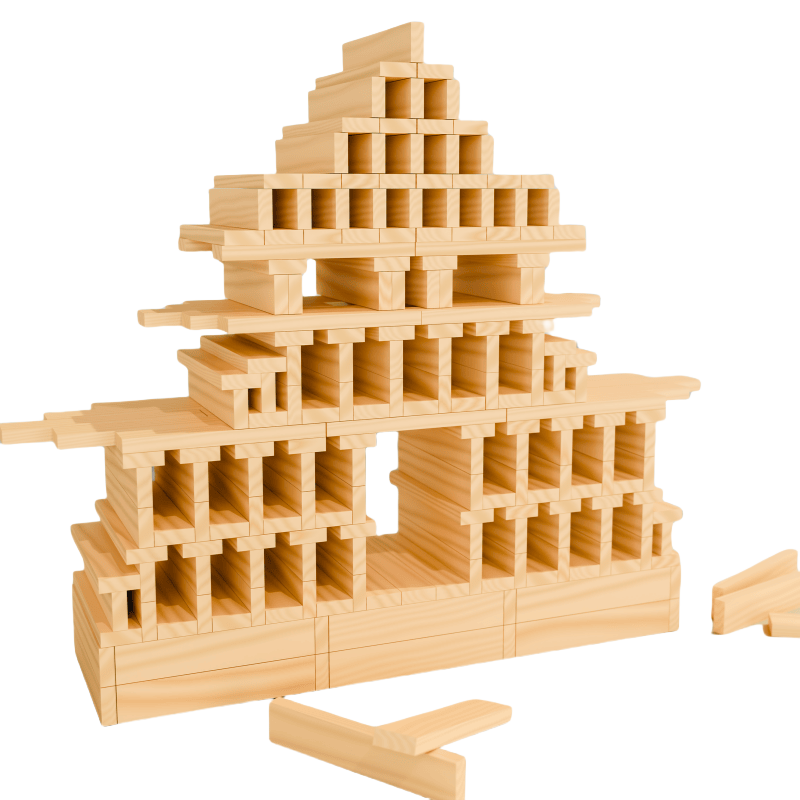
What Age Are Wooden Plank Blocks Right For? A Parent's Guide
Plank-style wooden blocks are usually sold as “3+”. That label is a safety minimum, not a statement about what a child can do with them. The useful answer is that the toy stays relevant from about three to about ten, but the play changes completely three times along the way.
Under three: not the right toy yet
Flat planks have no connectors, so a tower only stands if the child can place a piece and let go without knocking it. Most two-year-olds can stack a few, but the failure rate is high enough that the toy becomes frustrating rather than fun. The other consideration is that thin planks are easy to stand on and snap; a two-year-old will test exactly that.
If you want wooden blocks for a two-year-old, choose chunky cube blocks with rounded edges instead. Come back to planks at three.
Ages three to four: carrying, lining up, knocking down
At this stage the value is in handling, not building. Expect long rows laid end to end across the floor, deliberate collapses, and sorting by size or colour. This is normal and worth encouraging — the child is learning how the pieces behave.
- Use a tray or a shallow box so the pile stays in one place.
- Build alongside rather than instructing. Copy what the child does and extend it by one step.
- Keep the session short. Fifteen minutes of focused play is a good result at this age.
Ages four to six: the real starting point for building
This is when plank blocks start to pay off. A five-year-old can plan a simple structure, notice that a tower is leaning, and correct it. Towers, walls, simple bridges and domino runs all become possible, usually with an adult nearby.
This is also the age where the number of pieces starts to matter. Around 100 planks is enough to build something satisfying; 200 opens up bridges and multi-part structures. Below 50, the child runs out of material before the idea is finished, which is the most common reason a block set gets abandoned.
Ages seven to ten: engineering and self-set goals
Older children stop needing prompts. They will set their own constraints — the tallest tower that survives a door slam, the longest bridge that holds a book — and they will iterate. Plank blocks are one of the few toys that scale all the way up to this without changing.
At this age, mixed sets work well: a large plank set plus a handful of cubes and cylinders for pillars. The combination produces structures that neither alone can.
What actually matters for safety
- Small parts: planks are not a choking hazard at normal sizes, but check for splinters and cracked edges, especially on cheap sets.
- Surface finish: water-based, non-toxic finishes are the norm for reputable brands. If a set smells strongly of solvent when opened, return it.
- Stability: a tall build can topple onto a younger sibling. Build on the floor rather than a table once the child starts going above about 40 cm.
- Storage: a cloth bag or a lidded box prevents warping from damp. Wood that has absorbed moisture will bow and stop stacking flat.
How many pieces should you buy?
The honest answer: more than you think, but not as many as the largest set on the market. Two hundred planks is the sweet spot for a family with children between four and nine. It is enough for a tower, a bridge or a domino run, and it stores in a single bag.
If you are choosing between a small premium set and a large budget set, take the larger one at this age range. Plank play is limited by quantity far more than by finish quality.
For the mechanics of a good first build, see how to build a stable tower.
Sourcing wooden building blocks for retail or your own brand?
MOQ, lead times, EN71 / ASTM documentation — quoted within one business day.
Start here
Step-by-step tutorials · Building tips · Buying guide · FAQ · Wholesale & OEM