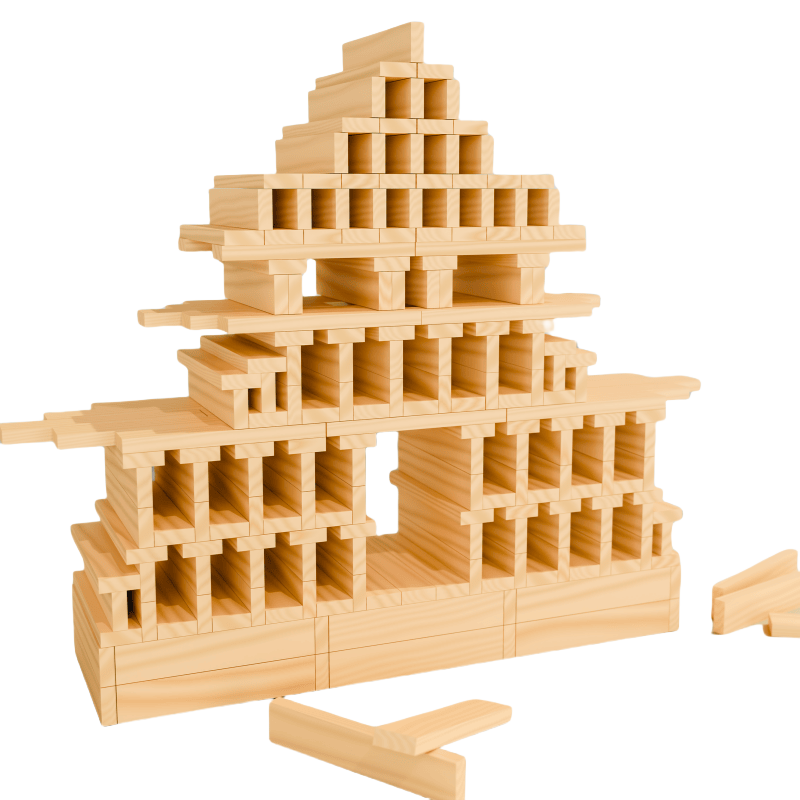
Five Plank-Block Building Challenges That Keep Kids Busy for an Hour
Plank blocks reward a specific kind of play: you cannot click two pieces together, so every structure has to balance. That makes them unusually good for short, rule-based challenges. Each of the five below takes ten to fifteen minutes and needs nothing but a pile of planks, a flat surface and a timer.
1. The tallest free-standing tower in ten minutes
Rules: ten minutes, no leaning against furniture or walls, the tower must stand unassisted for ten seconds after the timer stops.
What it teaches: base-to-height ratio. Children almost always start narrow and fast, watch the tower lean at around 20 cm, and then have to decide whether to widen the base or build a second, better tower. Both decisions are the point.
Make it easier (ages 4–5): drop the timer and allow a wall to lean against. Harder (ages 8+): require that the tower is at least four planks wide at the halfway mark.
2. The longest unsupported bridge
Rules: two stacks of books 30 cm apart, twenty minutes, the bridge must carry one small toy car across without touching the table.
What it teaches: span and load paths. A flat stack of planks will sag immediately; children discover that layering planks in alternating directions, or building a shallow arch, is what makes a span work. This is the challenge that most often produces a genuinely surprised face.
3. The one-plank-wide wall
Rules: build a wall at least 15 cm tall using single planks only — no doubled thickness, no pillars.
What it teaches: patience and joint offset. With no thickness to hide errors, every seam has to be staggered. Expect several collapses; that is the design, not a failure.
4. The domino run
Rules: stand planks on edge in a curve or zigzag; toppling the first must knock down all of them.
What it teaches: spacing and energy transfer. Planks that are too far apart stop the run; too close and they jam. Children calibrate the gap by trial, which is exactly the kind of feedback loop you want from a toy.
Variation: make the run cross a doorway or climb a gentle ramp made of a book.
5. Build a shape that has a name
Rules: twenty minutes to build something recognisable — a bridge, an animal, a chair — and the others have to guess it without being told.
What it teaches: abstraction and planning. Planks are unforgiving: a leg that is one plank too short is obvious, so children start sketching the shape in their head before touching the pile.
How to run a challenge session
- One clear rule at a time. Children handle a single constraint well and three badly.
- Announce the rule, then stay quiet. The value is in the attempt, not the instruction.
- Photograph the result before it comes down. A running gallery gives the next session a reference point and gives the child a reason to try something harder.
- End on a success. If the last build collapsed, rebuild the same thing together with one change.
How many planks do you need?
All five challenges work with about 200 planks. The bridge and the wall use the most; the domino run uses the fewest. If you only have 100, run challenges 3, 4 and 5 first, then combine two sets for the tower and the bridge.
For the mechanics behind the tower and the bridge, see how to build a stable tower with wooden planks.
Sourcing wooden building blocks for retail or your own brand?
MOQ, lead times, EN71 / ASTM documentation — quoted within one business day.
Start here
Step-by-step tutorials · Building tips · Buying guide · FAQ · Wholesale & OEM