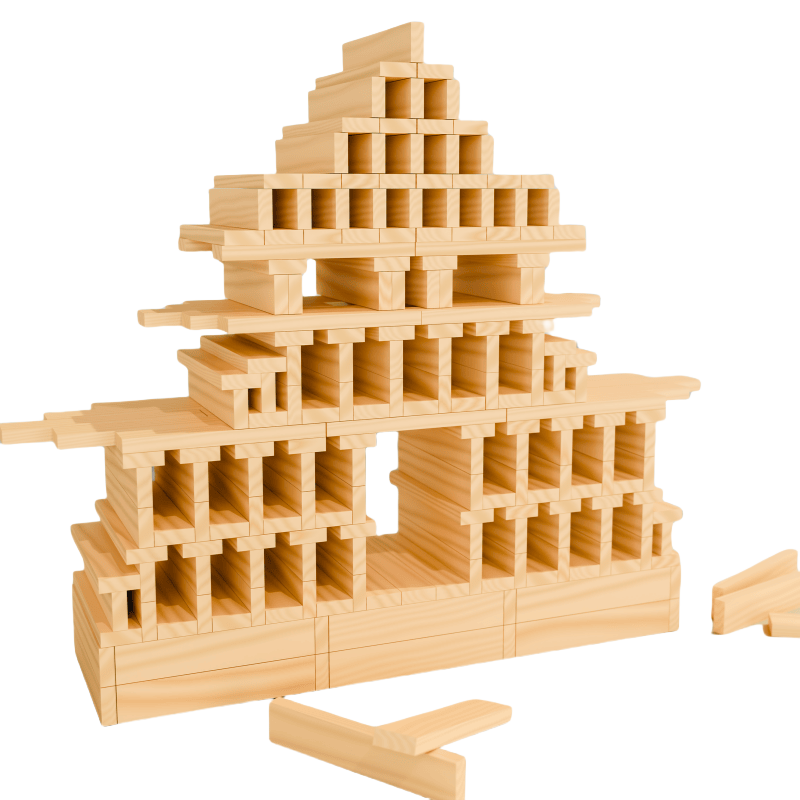
Teaching Symmetry With Blocks: Five Games That Take Ten Minutes
Symmetry is one of the few mathematical ideas a four-year-old can see, touch and get wrong in an obvious way. Blocks make it physical, which is why these five games work better than any worksheet.
1. Mirror building (ages 3–5)
You build half a shape on one side of a line made from a single plank laid flat; the child builds the other half so the two are mirror images.
Start with a shape that is only three or four planks wide, and place the mirror plank as a physical divider. The rule is simple: nothing may cross the line. When the child gets it right, the finished shape looks complete — that visual reward is what makes the game work.
What it teaches: reflection, and that symmetry is about position rather than size.
2. The symmetry hunt (ages 4–7)
Build one shape with an obvious line of symmetry and one that is deliberately asymmetric, then ask the child to find the line — using a plank as a test tool, laid across the shape.
The physical tool matters. A line drawn on paper can be argued with; a plank either matches the shape on both sides or it does not.
3. Rotational pattern (ages 6–9)
Build a quarter of a pattern, then rotate it by a quarter turn and build the same quarter again, three more times, until a full pinwheel is formed.
This is the game children find hardest and remember longest, because a rotation is not a reflection — the piece has to be turned, not flipped. Build the first quarter, then hand the child the planks for the second and let them work out that the shape must turn rather than mirror.
4. Symmetry in letters (ages 5–8)
Build capital letters from planks: A, H, M, T have a vertical line of symmetry; B and C do not but have a horizontal one; S has none.
Ask the child to sort the letters into three piles — vertical, horizontal, none — and then to prove each answer by building it and testing with a mirror plank. Proving is the point; sorting alone becomes a guessing game.
5. Fix the broken shape (ages 4–9)
Build a symmetric shape, then remove two or three planks without letting the child see which ones. They rebuild it.
Vary the difficulty by removing planks from the middle rather than the edge: a missing central plank breaks the symmetry in a way that is much harder to reason about than a missing corner.
Why blocks rather than drawings
A drawing of a symmetric shape is already symmetric — the answer is visible. A block construction is a set of decisions, and the child has to hold the mirror relationship in their head while placing each piece. The blocks make the mistake physical: a plank that crosses the line is obviously wrong the moment it lands.
What to have ready
- About 60 planks, sorted roughly by length so the child is not hunting.
- A flat surface, and one spare plank to use as the mirror line.
- A hand mirror for the reflection games — optional, but it makes the idea click faster.
For the structural rules that make these builds stable, see why plank structures collapse. For a progression of core builds, see your first five builds.
Sourcing wooden building blocks for retail or your own brand?
MOQ, lead times, EN71 / ASTM documentation — quoted within one business day.
Start here
Step-by-step tutorials · Building tips · Buying guide · FAQ · Wholesale & OEM