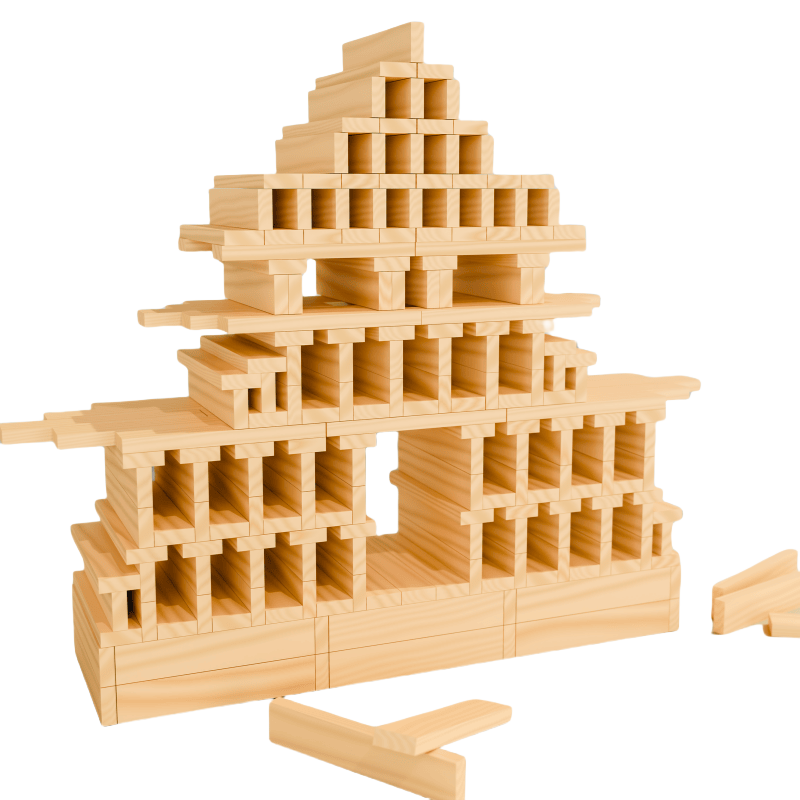
Block Play and Fine Motor Skills: What to Expect at Each Age
Plank blocks are usually discussed in terms of creativity and engineering. The more immediate effect, especially under six, is on the hands. Placing a plank on edge without knocking the row over is a precision task, and it is one children will attempt voluntarily for twenty minutes at a time.
Age three to four: grip and release
The dominant movement is a whole-hand grip followed by a controlled release. Placing a block and letting go without pushing it is harder than it looks: most three-year-olds press down and topple the piece in front of it.
What to watch for: a child who can place and release a plank without knocking the neighbour is developing the same inhibition control needed for drawing and, later, handwriting.
At this age, use larger, thicker planks. Thin pieces frustrate because they tip at the slightest touch.
Age four to five: stacking and alignment
Now the task becomes two-handed and requires aim: lining up edges, matching lengths, and stacking vertically. This is where the pincer grip gets exercised, because a plank has to be held between thumb and fingers at its centre of mass.
Progression sign: the child starts correcting their own misalignment before letting go, rather than after the tower falls. That correction is the skill.
Age five to seven: controlled placement and force
The interesting shift is force control. A child at this stage can place a plank gently enough that it does not disturb the layer below — the same light-touch control used for threading beads or using scissors accurately.
This is also when they start building with intent rather than experimenting, and when a verbal plan (“I am making a bridge”) begins to match what they build.
Age seven and up: precision under constraint
Older children work to a tolerance: a bridge that must hold a book, a tower that must survive a door slam. The motor demand becomes fine adjustment of already-placed pieces — nudging a plank two millimetres rather than rebuilding.
What block play does not do
It does not replace drawing or cutting for fine motor development. Blocks train placement and release; pencil work trains sustained pressure and directional control. They complement each other, and a child who is behind with a pencil will not catch up through blocks alone.
What blocks do better than most toys is train the child to plan a movement before making it, because the consequence is immediate and visible.
Simple activities that target the hand
- Row building: lay planks end to end in a straight line, then a curve. Aim for twenty without gaps.
- One-hand stacking: stack with the non-dominant hand resting behind the back.
- Precision placement: build a tower, then add planks to the top layer only, without touching the rest.
- Domino placement: stand planks on edge at even intervals — the tightest control exercise of the four.
When to step back
If a child is repeatedly failing at a task that looks age-appropriate, the set is probably wrong for them: too thin, too small, or too few pieces. Reducing the difficulty is not lowering expectations; it is what lets the practice continue.
For age-appropriate set sizes, see how many blocks you need. For the first builds to try, see your first five builds.
Sourcing wooden building blocks for retail or your own brand?
MOQ, lead times, EN71 / ASTM documentation — quoted within one business day.
Start here
Step-by-step tutorials · Building tips · Buying guide · FAQ · Wholesale & OEM