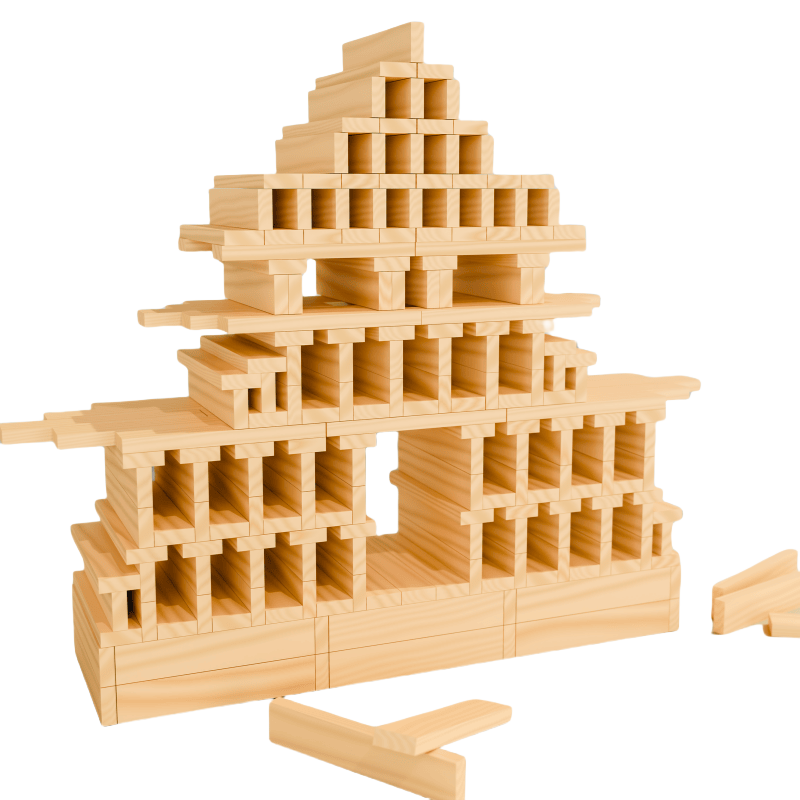
Wooden Blocks and Early Maths: Counting, Halves and Patterns
Blocks are unusually good for early maths because the quantities are visible and the child can move them. Counting a picture is a memory task; counting blocks is a physical one, and the two use different parts of the brain.
1. One-to-one counting (ages 3–4)
Counting aloud from memory often runs ahead of understanding. The test is whether the child can touch each block once, in order, and say one number per block.
Use a row of five planks. If the child counts to ten while touching five, the numbers are a song rather than a quantity. Start again with three, then five, then seven — nothing larger until the touching and the counting match.
2. Halves and quarters (ages 4–6)
Build a rectangle from eight identical planks, then ask the child to split it into two equal parts with one plank laid across as a line.
The physical check is the point: both halves have to contain the same number of planks. A child who says “half” and cuts a 5/3 split learns something from counting, not from being corrected.
Move on to quarters with twelve planks — twelve splits cleanly into halves and quarters, and the difference becomes visible immediately.
3. Repeating patterns (ages 4–7)
Lay out a pattern with two lengths: long, short, long, short. Ask the child to continue it. Then vary the rule: long, long, short; or long, short, short.
The step that matters is asking the child to describe the rule in words. Pattern recognition without naming is just copying; naming it is what transfers to number sequences later.
4. Rows as multiplication (ages 6–8)
Build a rectangle three planks wide and four high from identical pieces. Ask how many planks without counting them one by one.
A child who counts four in each row and adds — or better, says three times four — has just used multiplication as a structure rather than a table. Repeat with 3×5, 4×4 and 2×6, and ask what changes when you rotate the rectangle. The answer (nothing) is the commutative property, discovered rather than taught.
5. Estimation (ages 5–9)
Put twenty planks in a cloth bag. Ask the child to estimate how many before opening it. Then count. Repeat with a different number.
Estimation is the least practised early-maths skill and the easiest to run with blocks. Children improve quickly, and the improvement is measurable across a week.
Why blocks rather than counters
Counters are identical and small, which makes them easy to lose and uninteresting to handle. Planks can be stacked, so a group of ten can be represented as a tower as well as a row — and the tower gives the child a second way of seeing the quantity.
Keeping it short
Ten minutes is enough for any of these. The moment the child starts treating the blocks as toys rather than quantities, stop: the maths has ended and the play has started, and both are fine, but only one of them is the lesson.
For the fine-motor side of the same activity, see block play and fine motor skills. For symmetry games, see teaching symmetry with blocks.
Sourcing wooden building blocks for retail or your own brand?
MOQ, lead times, EN71 / ASTM documentation — quoted within one business day.
Start here
Step-by-step tutorials · Building tips · Buying guide · FAQ · Wholesale & OEM